





AI Shopping Assistant for eCommerce: Complete Guide
An AI shopping assistant for eCommerce is becoming one of the most powerful tools for online stores, marketplace apps, D2C brands, retail businesses, and mobile commerce platforms. Customers no longer want to search through hundreds of products, apply many filters, read long descriptions, compare multiple tabs, and still feel confused. They want fast answers, personal guidance, product comparison, smart suggestions, and a simple buying journey. This is exactly where AI shopping assistant services can help an eCommerce business improve product discovery, user experience, conversion rate, customer support, and repeat sales.
ChatGPT has changed how people search, compare, and make decisions online. Now, the same kind of conversational product discovery can be added to an eCommerce website or app. A ChatGPT like shopping assistant can understand customer intent, ask smart questions, recommend suitable products, compare options, explain features, answer product questions, help with sizing or compatibility, and guide users toward the right purchase.
For eCommerce businesses, this is not just a chatbot upgrade. It creates a smarter way to sell products online. Traditional search depends on exact keywords, so customers must know what to type before they can find the right product. Manual filters also take time, and long product pages often make the buying journey more confusing. In comparison, a smart AI shopping assistant works like a personal product guide. It understands natural language, follows customer context, and recommends suitable products even when the buyer does not know the exact product name.
For example, a normal search bar may fail when a customer writes, “I need a budget laptop for office work, video meetings, and light editing.” An AI product search for eCommerce can understand this request and suggest products based on budget, RAM, processor, battery life, screen size, webcam quality, reviews, stock status, and price. This makes the shopping journey faster and more helpful.
This blog explains how to add a ChatGPT shopping-like AI assistant to your eCommerce website or app. It also explains the features, technical architecture, data requirements, user flow, development process, integrations, business benefits, SEO benefits, and why Depex Technologies can help your business build a custom AI shopping assistant for eCommerce.
What Is an AI Shopping Assistant for eCommerce?
An AI shopping assistant for eCommerce is a smart digital assistant that helps customers find, compare, understand, and buy products through conversation. It can be added to a website, mobile app, marketplace, WhatsApp, CRM, or customer support system.
Unlike a basic chatbot, an AI shopping assistant does not only answer fixed questions. It can understand buyer intent and provide intelligent suggestions based on live product data, catalog information, user preferences, pricing, stock availability, product attributes, reviews, and business rules.
A basic chatbot may answer questions like:
“What is your return policy?”
“Where is my order?”
“How can I contact support?”
An AI shopping assistant can answer much more advanced shopping questions like:
“Which phone is best under 25000 with good camera and battery?”
“Show me cotton dresses for summer under 1500.”
“Compare these two washing machines for a family of four.”
“I want office shoes that are comfortable for daily use.”
“Find products similar to this uploaded image.”
“Which skincare product is suitable for oily skin?”
“Suggest a gift for my wife under 3000.”
This makes the assistant useful across the complete buyer journey. It can support discovery, comparison, decision-making, checkout guidance, post-purchase support, order tracking, returns, and upselling.
Why eCommerce Businesses Need AI Shopping Assistant Services
Online shopping has become highly competitive. Many eCommerce businesses spend heavily on ads, SEO, social media, influencer marketing, and marketplace promotions. However, when a customer lands on the website, the shopping experience often still depends on an old search bar, static filters, and long product listing pages.
This creates a major gap. Businesses bring traffic, but customers leave because they cannot quickly find the right product.
AI shopping assistant services help solve this problem by making product discovery easier, faster, and more personal. When a customer gets guided help instantly, they are more likely to stay, compare, trust the brand, and buy.
How a ChatGPT Like Shopping Assistant Works
A ChatGPT like shopping assistant works through a combination of AI models, product data, search technology, business logic, and integrations. The goal is to give users accurate and useful product recommendations from your own catalog.
Here is a simple explanation of how it works.
Step 1: The Customer Asks a Question
The customer types or speaks a question in natural language.
Example:
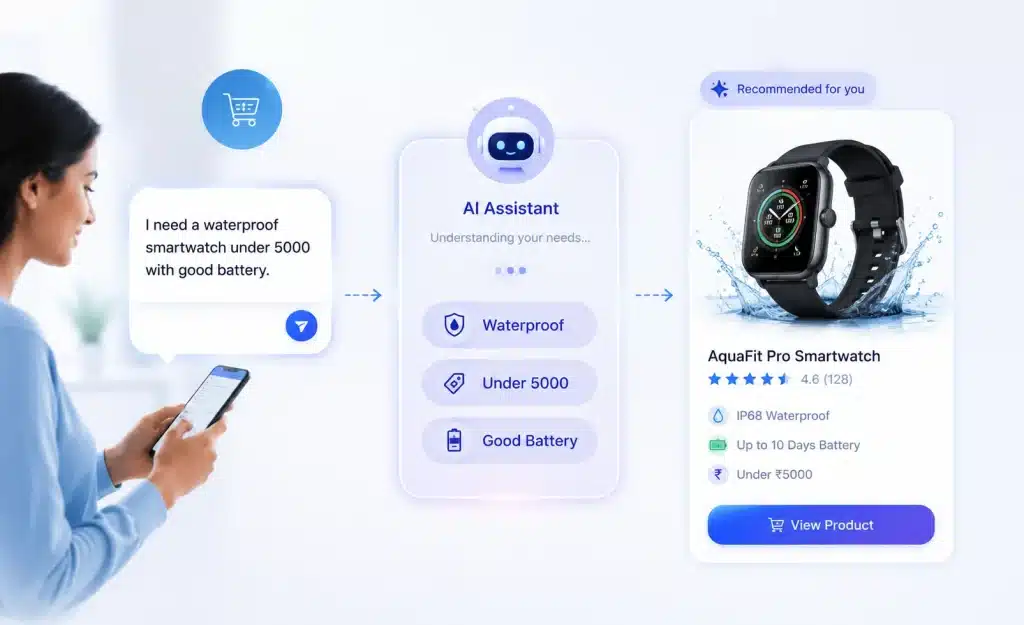
“I need a waterproof smartwatch under 5000 with good battery.”
The AI assistant understands the intent. It knows the customer is looking for a smartwatch with three constraints: waterproof, price under 5000, and good battery.
Step 2: The Assistant Understands Intent and Context
The assistant identifies product category, budget, features, preferences, and possible hidden needs.
In this example, it may detect:
Product category: smartwatch
Budget: under 5000
Feature: waterproof
Preference: good battery
Possible additional filters: brand, screen size, warranty, rating
If needed, it can ask a clarifying question.
Example:
“Do you prefer calling features, fitness tracking, or longer battery backup?”
This makes the result more accurate.
Step 3: The Assistant Searches the Product Catalog
The assistant connects with your product database, product feed, website API, Shopify store, WooCommerce store, Magento store, Laravel backend, custom eCommerce system, ERP, or inventory system.
It searches relevant products using semantic search, keyword search, filters, product attributes, and ranking logic.
Semantic search is important because it understands meaning, not just exact words. For example, it can connect “office laptop” with products tagged as business laptops, productivity laptops, long battery laptops, or lightweight laptops.
Step 4: The Assistant Applies Business Rules
A business may want to promote in-stock products, high-margin products, new arrivals, bestsellers, products with higher ratings, products available for fast delivery, or products from selected brands.
The AI assistant can follow these rules while still keeping recommendations useful and honest.
Business rules can include:
Show only in-stock products.
Prioritize products with rating above 4.
Show products within the customer budget.
Avoid discontinued products.
Suggest accessories after main product selection.
Recommend bundles when relevant.
Follow regional availability rules.
Apply discount or offer logic.
This makes the assistant useful for both customers and business owners.
Step 5: The Assistant Gives Product Recommendations
The assistant shows a clear answer with product cards, images, price, features, stock status, ratings, comparison points, and direct add-to-cart buttons.
A good AI shopping assistant for eCommerce should not only show products. It should explain why each product is recommended.
Example:
Product A is the best option for longer battery life. If calling features matter more, Product B is a better choice. For budget-focused buyers, Product C gives the most affordable value.
This helps customers make a confident decision.
Step 6: The Assistant Helps With Checkout
After product selection, the assistant can guide the customer to cart, coupon application, delivery check, payment options, and checkout.
For apps, it can deep link users to the product page or cart screen. For websites, it can open the product page, add products to cart, or trigger checkout flow based on the platform capability.
Step 7: The Assistant Learns and Improves
The assistant can collect feedback such as:
Not interested
Show more like this
Lower price
Different color
Compare with another product
Need faster delivery
This feedback improves results during the current session and can help businesses understand customer intent better.
Key Features of a Powerful AI Shopping Assistant
A strong AI shopping assistant for eCommerce should include features that support product discovery, decision-making, customer support, and sales growth. Below are the most important features.
1. Natural Language Product Search
Customers should be able to search in normal human language. They should not need to know exact product names or technical keywords.
Examples:
“Show me party wear sarees under 3000.”
“I want a laptop for coding and college.”
“Find me a baby stroller that is lightweight and easy to fold.”
“Suggest protein-rich snacks for gym users.”
Natural language product search makes the website easier for every type of customer.
2. Smart Clarifying Questions
A good AI assistant should not guess when the query is incomplete. It should ask useful follow-up questions.
Example:
Customer: “I need a gift.”
Assistant: “Who is the gift for, what is your budget, and what occasion is it for?”
This improves recommendation accuracy and creates a personal shopping experience.
3. Product Comparison
Product comparison is one of the most important features of a ChatGPT like shopping assistant. Many customers get stuck while choosing between two or more products.
The AI assistant can compare:
Price
Features
Material
Size
Warranty
Rating
Reviews
Delivery time
Best use case
Pros and cons
This can reduce decision time and improve purchase confidence.
4. Personalized Recommendations
The AI assistant can recommend products based on browsing behavior, past purchases, wishlist, cart activity, location, and preferences.
Examples:
“Since you bought a camera, you may need a memory card and tripod.”
“Based on your last order, you may like these skincare products.”
“You viewed running shoes. Here are similar shoes with better cushioning.”
Personalized recommendations can increase average order value.
5. Visual Product Search
Visual search allows customers to upload an image and find similar products. This is highly useful for fashion, furniture, home decor, jewelry, eyewear, shoes, accessories, and lifestyle products.
A customer can upload a dress image and ask:
“Find something like this under 2000.”
The assistant can search for similar colors, style, pattern, length, material, and price range.
6. Voice Shopping Assistant
Voice search is useful for mobile apps, grocery platforms, elderly users, local commerce, and quick shopping experiences. Customers can speak their requirement instead of typing.
Example:
“Add atta, rice, sugar, and green tea to my cart.”
This can make repeat buying faster.
7. Size and Fit Assistant
Fashion and footwear brands often face high returns because of size confusion. An AI shopping assistant can guide customers based on size chart, previous purchase, body measurements, fit preference, product reviews, and brand-specific sizing.
It can answer:
“Is this true to size?”
“Should I buy medium or large?”
“Which size is best for 32 waist?”
This can reduce returns and improve customer satisfaction.
8. Compatibility Assistant
Electronics, auto parts, industrial products, software, accessories, and hardware stores need compatibility checks.
Examples:
“Will this charger work with my phone?”
“Is this RAM compatible with my laptop?”
“Does this filter fit my machine?”
“Can this plugin work with my Shopify theme?”
A compatibility assistant can prevent wrong purchases and reduce support tickets.
9. Guided Selling Flow
Guided selling is a structured conversation that helps customers choose the right product step by step.
For example, a skincare store may ask a few guided questions before recommending products:
What is your skin type?
Which skin concern do you want to solve?
Please select your age group.
Do you prefer natural skincare products?
What is your budget?
Then the assistant recommends a suitable product routine.
Guided selling works very well for beauty, health, electronics, furniture, insurance, education products, B2B products, and customized products.
10. Add to Cart and Checkout Integration
The assistant should support direct actions like:
Add product to cart
Apply coupon
Check delivery availability
Show shipping charges
Move to checkout
Save to wishlist
Share product
Book consultation
Request quote
This turns the assistant from a support tool into a sales tool.
11. Order Tracking and Post-Purchase Support
AI shopping assistant services can also include post-purchase support. Customers can ask:
“Where is my order?”
“How can I return this product?”
“When will my refund come?”
“Can I exchange size?”
The assistant can connect with order management systems, courier APIs, CRM, and support tools.
12. Multilingual Shopping Support
India and global markets need multilingual shopping support. An AI shopping assistant can talk in English, Hindi, Hinglish, French, Spanish, Arabic, and other languages based on the customer base.
For Indian eCommerce businesses, Hinglish support can be very useful because many users search in mixed language.
Example:
“Mujhe office ke liye comfortable shoes chahiye under 2000.”
A smart assistant can understand this and show relevant products.
13. Admin Dashboard and Analytics
The business owner should get a dashboard to track AI performance.
Important metrics include:
Most searched products
Queries with no results
Top customer questions
Conversion from assistant
Products recommended most often
Products added to cart from AI assistant
Abandoned conversations
Customer intent trends
Popular price ranges
Support queries handled by AI
These insights help improve catalog, pricing, content, inventory, and marketing strategy.
Technical Architecture of an AI Shopping Assistant
To build a reliable AI shopping assistant for eCommerce, the system needs a strong technical architecture. The assistant should not give random answers. It should answer from your real product data and business rules.
Here is a practical architecture.
1. User Interface Layer
This is the visible part of the assistant. It can appear as:
Chat widget on website
Search bar with AI mode
Mobile app assistant
Voice assistant
WhatsApp assistant
Product page assistant
Cart assistant
Support assistant
The interface should be simple, fast, mobile responsive, and easy to use.
2. AI Conversation Layer
This layer handles natural language understanding, intent detection, question answering, and conversation flow. It understands what the customer wants and decides what action to take.
It can manage:
Product search queries
Comparison requests
Support questions
Order tracking
Clarifying questions
Recommendation logic
Checkout guidance
3. Product Data Layer
This is one of the most important parts. AI is only as good as the data behind it. Your product data should be clean, structured, complete, and updated.
Product data should include:
Product name
Category
Brand
Price
Sale price
Stock status
Images
Attributes
Size
Color
Material
Description
Specifications
Warranty
Return policy
Delivery information
Reviews
Ratings
Tags
Use cases
FAQs
Good product data helps the assistant give better answers.
4. Search and Retrieval Layer
This layer finds relevant products from the catalog. It can use a combination of:
Keyword search
Semantic search
Vector search
Filters
Attribute matching
Personalization
Business rules
Ranking algorithm
For best results, eCommerce businesses should use hybrid search. Hybrid search combines keyword matching and semantic understanding. This helps the assistant handle exact product names and broad intent-based queries.
5. Business Logic Layer
Every eCommerce business has different rules. The assistant should follow these rules.
Examples:
Do not recommend out-of-stock products.
Promote active offers.
Show only serviceable products for selected pin code.
Follow minimum order value rules.
Suggest products based on margin priority.
Show B2B bulk pricing only to approved users.
Avoid recommending restricted products to minors.
Show region-specific inventory.
Business logic makes the AI assistant practical for real commerce.
6. Integration Layer
The assistant must connect with existing platforms.
Common integrations include:
Shopify
WooCommerce
Magento
Laravel eCommerce
Custom PHP eCommerce
MERN stack apps
React Native apps
Flutter apps
ERP
CRM
Payment gateway
Inventory system
Courier APIs
WhatsApp API
Email marketing tools
Analytics tools
Support ticket systems
A custom AI shopping assistant development company like Depex Technologies can build these integrations based on your current system.
7. Safety and Accuracy Layer
AI assistants must be controlled. They should not invent product details, fake prices, false availability, or wrong warranty claims.
Safety controls should include:
Answer from verified catalog data.
Show confidence level where needed.
Redirect to human support for sensitive cases.
Avoid false medical, financial, or legal claims.
Keep pricing and stock synced.
Log uncertain queries.
Use approved brand tone.
Follow privacy rules.
This is very important for customer trust.
Best Product Data Strategy for AI Product Search for eCommerce
If you want a powerful AI shopping assistant for eCommerce, your product data must be AI-ready. Many online stores have product data written only for human browsing. AI search needs more structure and clarity.
Here is how to prepare product data.
1. Use Clear Product Titles
Product titles should be descriptive but not overloaded.
Weak title:
“Premium Model 5000”
Better title:
“Premium Stainless Steel 1.5L Electric Kettle with Auto Cut-Off”
AI needs clear titles to understand the product.
2. Add Detailed Product Attributes
Attributes are more important than long marketing descriptions.
For fashion, add:
Size
Color
Fabric
Fit
Occasion
Pattern
Sleeve type
Wash care
For electronics, add:
Processor
RAM
Storage
Battery
Screen size
Warranty
Connectivity
Compatibility
For furniture, add:
Material
Dimensions
Color
Room type
Weight capacity
Assembly requirement
The more structured your attributes are, the better your AI product search becomes.
3. Add Use Case Information
Customers often search by use case.
Examples:
Best for office work
Suitable for gaming needs
Recommended for oily skin
Ideal for small rooms
Perfect for gifting
Useful for travel
Great choice for beginners
Adding use case tags helps the AI assistant recommend products more accurately.
4. Keep Price and Stock Updated
If the AI assistant recommends a product that is out of stock, the customer experience becomes poor. Real-time or frequent sync with inventory is important.
For high-volume stores, stock and pricing should be updated automatically through APIs or scheduled feeds.
5. Add Product FAQs
Product FAQs help the assistant answer customer questions. Each product page should include common questions.
Examples:
Is this product washable?
Does it come with warranty?
Is it suitable for kids?
Can it be returned?
What is included in the box?
Will it fit my device?
These FAQs can improve both SEO and AI answer accuracy.
6. Improve Product Descriptions
Product descriptions should be clear, factual, and helpful. Avoid only promotional language. AI assistants need real information.
Good descriptions include:
What the product is
Who it is for
Key benefits
Technical details
Usage guidance
Care instructions
Limitations
Warranty details
This helps both customers and AI search engines understand the product.
How to Add a ChatGPT Like Shopping Assistant to Your Website
Adding a ChatGPT like shopping assistant to your eCommerce website requires planning, development, testing, and optimization. Here is a step-by-step process.
Step 1: Define the Business Goal
Before development, decide what the assistant should do.
Goals may include:
Improve product search
Increase conversion rate
Reduce support queries
Provide product comparison
Increase average order value
Improve mobile shopping
Support multilingual customers
Handle B2B product enquiries
Generate qualified leads
For example, a fashion brand may focus on size guidance and visual search. An electronics store may focus on comparison and compatibility. A grocery app may focus on repeat orders and voice shopping.
Step 2: Audit the Current eCommerce Platform
The development team should review your existing website or app.
Important checks include:
Platform type
Product catalog structure
Search functionality
API availability
Inventory system
Cart and checkout flow
User login system
Order management
Hosting performance
Database structure
Third-party integrations
This helps decide the best technical approach.
Step 3: Prepare Product Data
Product data should be cleaned, structured, and mapped before AI integration. Missing attributes should be added. Categories should be corrected. Duplicate products should be removed. Product descriptions should be improved.
This step is critical. Without clean data, the AI assistant cannot perform well.
Step 4:
Choose the AI Model and Search System
The assistant can be built using OpenAI models or other suitable AI models depending on the business requirement, budget, privacy needs, and performance expectations.
AI Model Layer
The AI shopping assistant can use OpenAI models or other suitable AI models. The right model depends on how the business wants the assistant to answer, recommend, compare, and support customers.
Search System May Include
A strong AI shopping assistant uses a search system that can understand customer intent, product data, catalog structure, and ranking rules.
Best Setup Depends on Your eCommerce Business
The best setup depends on catalog size, traffic, and platform type. A custom AI shopping assistant should be planned according to your store structure, customer journey, and growth goals.
Step 5: Build the Conversation Flow
The assistant should have a well-designed conversation flow. It should know when to answer, when to ask questions, when to recommend products, and when to hand over to a human agent.
Important flows include:
Product search flow
Comparison flow
Gift recommendation flow
Size guide flow
Compatibility flow
Order tracking flow
Return support flow
Cart recovery flow
Human handover flow
A good flow makes the assistant useful and controlled.
Step 6: Integrate With Product Catalog and Cart
The assistant should connect with your live product catalog. It should also support actions like add to cart, open product page, save to wishlist, or start checkout.
For WooCommerce, Shopify, Magento, Laravel, PHP, MERN, React Native, and Flutter apps, different integration methods may be used.
Step 7: Add Personalization
Personalization can be added using user history, preferences, location, previous purchases, and browsing behavior. However, privacy should be respected. Users should know how their data is used.
Step 8: Test Accuracy and User Experience
Testing is very important before launch.
Test cases should include:
Exact product search
Broad product search
Misspelled queries
Mixed language queries
Budget-based queries
Feature-based queries
Out-of-stock products
Wrong product questions
Comparison questions
Checkout questions
Return policy questions
The assistant should be tested with real customer-like queries.
Step 9: Launch in Phases
A phased launch is usually the safest approach for an AI shopping assistant.
In the first phase, the system can include AI product search and FAQ support.
During the second phase, the assistant can add product comparison, personalized recommendations, and add to cart functionality.
After the core experience is stable, the third phase can include visual search, voice search, personalization, analytics, and advanced automation.
This approach reduces risk, improves quality, and helps the business test each feature before expanding the system.
Step 10: Monitor and Improve
After launch, track performance regularly. Improve product data, answer quality, search ranking, and conversation flows based on real user behavior.
How to Add an AI Shopping Assistant to a Mobile App
Mobile commerce needs a slightly different approach. App users expect fast, smooth, and simple experiences. The AI assistant should feel native inside the app.
For mobile apps, the assistant can be added as:
Floating chat icon
AI search tab
Voice shopping screen
Product page assistant
Cart assistant
Personal shopper section
Notification-based recommendation system
The assistant should support deep links. When it recommends a product, the user should be able to open the exact product page inside the app. It should also support app cart, wishlist, payment flow, user login, order tracking, and push notifications.
For example, a user may ask:
“Show me running shoes under 3000.”
The assistant can show products inside the app and allow the user to add one to cart instantly.
For apps built in Flutter, React Native, native Android, native iOS, or hybrid frameworks, Depex Technologies can create a custom integration based on your existing app architecture.
Business Benefits of AI Shopping Assistant Development
A custom AI shopping assistant can create strong business benefits for eCommerce brands.
1. Better Customer Experience
Customers get quick answers and personalized help. They do not need to browse endlessly. This makes the shopping journey smoother.
2. Higher Conversion Rate
When customers receive the right guidance, they are more likely to buy. The assistant reduces confusion and improves trust.
3. Increased Average Order Value
The assistant can suggest relevant add-ons, bundles, accessories, and upgrades.
Example:
A customer buying a camera can be shown a memory card, tripod, camera bag, and lens cleaner.
4. Lower Support Cost
AI can answer many repetitive questions. This saves time for support teams.
5. Better Product Discovery
Products that are difficult to find through normal search can be discovered through intent-based AI search.
6. Stronger Customer Engagement
Conversation keeps users engaged longer. The assistant can guide, educate, and recommend in real time.
7. Useful Customer Insights
The assistant can reveal what customers are actually looking for. This can help with product planning, SEO, ads, and inventory.
8. Competitive Advantage
Many eCommerce websites still use old search systems. Adding an AI shopping assistant can make your website or app feel more modern and helpful.
AI Shopping Assistant and SEO Benefits
An AI shopping assistant can also support SEO when implemented correctly. It can help improve site engagement, product content quality, internal search experience, and structured content.
However, the assistant should not replace normal SEO pages. Your product pages, category pages, blogs, FAQs, schema markup, and internal links should still be optimized.
AI-first search friendly eCommerce websites should include:
Clear product information
Structured data
Helpful FAQs
Comparison content
Use case pages
Buying guides
Clean category structure
Fast loading pages
Mobile-friendly design
Updated product feed
Human-readable and machine-readable content
When your website has better structured content, it becomes easier for Google, ChatGPT, and other AI search engines to understand your products and business.
AI-First Search Friendly Content Strategy for eCommerce
AI search engines prefer clear, helpful, well-structured, and factual content. If you want your eCommerce website to be discoverable in AI-first search, your content should answer real customer questions.
Build Content That AI Search Engines Can Understand
AI-first search is changing how customers discover products. Instead of only matching keywords, AI systems look for useful answers, clear product context, helpful comparisons, and topic depth.
For eCommerce websites, this means every important category should be supported by useful content that answers buying questions.
Create Content Like
These content types make your store easier to crawl, easier to understand, and more useful for both users and AI search engines.
Example: Turn a Basic Category Into AI-Friendly Content
Instead of only having a category page called “Smartwatches,” create helpful pages that answer specific buyer questions.
Smartwatches
A single category page may not answer detailed customer questions about budget, fitness tracking, calling features, or beginner-friendly options.
Better Supporting Pages
- Best Smartwatches Under 5000
- Best Smartwatches for Fitness Tracking
- Smartwatch Buying Guide for Beginners
- Smartwatch With Calling Feature: What to Check Before Buying
Why This Strategy Works
These pages help both traditional SEO and AI search visibility because they answer real customer questions, support product discovery, and make your eCommerce content easier to understand.
Common Mistakes to Avoid
Many businesses want AI shopping assistant development, but they make mistakes that reduce performance.
Mistake 1: Using AI Without Product Data
If the assistant is not connected to real product data, it may give generic answers. A shopping assistant must be connected to the catalog.
Mistake 2: Ignoring Stock and Price Updates
Wrong price or stock information can damage trust. Always sync live data.
Mistake 3: Making the Assistant Too Generic
The assistant should understand your business, products, policies, and brand tone. A generic chatbot is not enough.
Mistake 4: No Human Handover
Some queries need human support. The assistant should know when to transfer the conversation.
Mistake 5: Poor Mobile Experience
Most eCommerce traffic comes from mobile devices. The assistant must work smoothly on mobile.
Mistake 6: No Analytics
Without analytics, you cannot improve. Track queries, conversions, failed searches, and customer feedback.
Mistake 7: Overpromising With AI
The assistant should not make false claims. It should answer based on verified data and business rules.
Best Industries for AI Shopping Assistant Services
AI shopping assistant services can help many industries.
Fashion and Apparel
Fashion brands can use AI for size guidance, outfit recommendations, style suggestions, visual search, and occasion-based shopping.
Beauty and Skincare
Beauty stores can use AI for skin type recommendations, product routines, ingredient questions, shade matching, and concern-based search.
Electronics
Electronics stores can use AI for product comparison, compatibility checks, technical explanation, warranty questions, and budget-based recommendations.
Grocery and Quick Commerce
Grocery apps can use AI for repeat orders, voice shopping, recipe-based cart building, and smart substitutions.
Furniture and Home Decor
Furniture stores can use AI for room-based recommendations, size matching, style search, material comparison, and visual inspiration.
Jewelry and Accessories
Jewelry brands can use AI for occasion-based gifts, style matching, budget recommendations, and visual search.
Healthcare and Medical Supplies
Medical supply stores can use AI for product discovery, bulk enquiry support, product specification guidance, and procurement assistance. Sensitive medical claims should be handled carefully and reviewed by experts.
B2B eCommerce
B2B platforms can use AI for bulk order support, technical product matching, RFQ generation, vendor coordination, and procurement guidance.
Marketplace Platforms
Marketplaces can use AI to help users search across many sellers, compare products, filter by trust signals, and find the best option quickly.
Important Integrations for an AI Shopping Assistant
A complete AI shopping assistant for eCommerce may need several integrations.
eCommerce Platform Integration
The assistant should connect with your store platform such as Shopify, WooCommerce, Magento, Laravel, PHP, MERN, or custom backend.
Inventory Integration
This keeps product availability updated.
Payment Gateway Integration
This helps the assistant guide users toward checkout.
CRM Integration
This helps capture leads, customer intent, and follow-up opportunities.
WhatsApp Integration
Many customers prefer WhatsApp for product enquiries. The assistant can help answer product questions on WhatsApp.
Courier API Integration
This helps answer delivery status and shipping questions.
Analytics Integration
This helps track AI performance and conversion.
Admin Panel Integration
Business teams need control over product rules, promotions, responses, and conversation logs.
Estimated Development Scope
The cost and timeline of AI shopping assistant development depends on features, platform, catalog size, integrations, and complexity.
A Basic AI Shopping Assistant May Include
A basic version is suitable for eCommerce businesses that want to start with essential AI shopping support and simple product discovery.
- Website chat widget
- Product search
- FAQ answers
- Basic product recommendations
- Admin training data
- Simple analytics
A Mid-Level AI Shopping Assistant May Include
A mid-level solution is useful for stores that want smarter search, better personalization, product comparison, and stronger customer support.
- Semantic product search
- Personalized recommendations
- Product comparison
- Add to cart integration
- Order tracking
- Multilingual support
- CRM integration
- Advanced analytics
An Advanced AI Shopping Assistant May Include
An advanced version is best for eCommerce platforms, marketplaces, mobile apps, and B2B portals that need deeper automation and enterprise-level integrations.
- Visual search
- Voice search
- Deep personalization
- AI product feed optimization
- Mobile app integration
- Advanced recommendation engine
- B2B quotation flow
- ERP integration
- Custom dashboard
- Human handover
- Security controls
Need the Right Development Plan for Your Store?
Depex Technologies can review your current eCommerce website or app and suggest the best development approach based on your business goals.
How Depex Technologies Builds an AI Shopping Assistant
Depex Technologies follows a practical and business-focused approach to AI shopping assistant development.
1. Requirement Analysis
The team understands your business, product categories, customer journey, target audience, platform, pain points, and expected outcomes.
2. Platform and Data Audit
Depex Technologies checks your website, app, catalog, database, APIs, product attributes, search system, and checkout flow.
3. AI Strategy Planning
The team defines the right AI model, search system, data flow, integration method, and assistant features.
4. UI and Conversation Design
The assistant interface and conversation flow are designed for easy use, mobile responsiveness, and better conversion.
5. Product Data Preparation
Product catalog data is cleaned, structured, and optimized for AI product search for eCommerce.
6. Development and Integration
The assistant is developed and integrated with your website, app, catalog, cart, CRM, order system, and other tools.
7. Testing and Quality Check
The assistant is tested with real shopping queries, edge cases, product comparisons, stock logic, price logic, and support questions.
8. Launch and Optimization
After launch, Depex Technologies helps monitor performance and improve answer accuracy, product ranking, user experience, and conversion.
Why Choose Depex Technologies for AI Shopping Assistant Services?
Depex Technologies is a custom web, app, and AI development company that helps businesses build modern digital solutions. If you want to add an AI shopping assistant for eCommerce to your website or app, Depex Technologies can help you plan, design, develop, integrate, test, and launch the complete solution.
Here is why businesses can choose Depex Technologies.
Custom Development
Every eCommerce business is different. Depex Technologies builds custom AI shopping assistant solutions based on your platform, products, audience, and business model.
Website and App Expertise
The team works on website development, app development, custom software, eCommerce platforms, CRM, APIs, and automation. This makes integration easier.
AI and Automation Focus
Depex Technologies can help add AI product search, AI chatbot, AI recommendation engine, AI support assistant, and AI-powered automation to your business.
Cost-Effective Development
The goal is to build practical AI solutions that are useful, scalable, and cost-effective for businesses.
Business-Oriented Approach
The focus is not only on AI technology. The focus is on business results such as more enquiries, better conversion, lower support load, and improved customer experience.
End-to-End Support
Depex Technologies can help from planning to development, launch, and ongoing improvement.
FAQ: AI Shopping Assistant for eCommerce
Find answers to common questions about AI shopping assistant development, ChatGPT like shopping assistants, product search, mobile app integration, and eCommerce automation.
What is an AI shopping assistant for eCommerce?
An AI shopping assistant for eCommerce is a smart assistant that helps customers search, compare, and buy products through conversation. It understands natural language and recommends suitable products from the store catalog.
How is an AI shopping assistant different from a normal chatbot?
A normal chatbot usually answers fixed questions. An AI shopping assistant understands buyer intent, searches product data, compares options, gives recommendations, and helps customers make purchase decisions.
Can I add a ChatGPT like shopping assistant to my existing website?
Yes. A ChatGPT like shopping assistant can be added to an existing eCommerce website if product data and platform integrations are available. It can be integrated with Shopify, WooCommerce, Magento, Laravel, PHP, MERN, and custom platforms.
Can an AI shopping assistant work inside a mobile app?
Yes. It can be integrated into Android, iOS, Flutter, React Native, and other mobile app systems. It can support product search, voice search, product recommendation, cart actions, and order tracking.
Does an AI shopping assistant improve sales?
It can help improve sales by reducing search friction, giving personal recommendations, answering customer questions, and helping users choose the right product faster.
What data is required to build an AI shopping assistant?
You need product titles, descriptions, prices, stock status, categories, attributes, images, reviews, FAQs, policies, order data, and business rules. Better data creates better AI results.
Can the assistant recommend products in different languages?
Yes. A multilingual AI shopping assistant can support English, Hindi, Hinglish, French, Spanish, Arabic, and other languages based on your target customers.
Can AI shopping assistant services include visual search?
Yes. Visual search can be added for categories like fashion, furniture, jewelry, accessories, shoes, and home decor. Customers can upload an image and find similar products.
Is AI shopping assistant development suitable for small eCommerce businesses?
Yes. Small businesses can start with a basic AI product search and FAQ assistant, then later add advanced features like comparison, personalization, visual search, and analytics.
How long does it take to develop an AI shopping assistant?
The timeline depends on features and integrations. A basic version can be developed faster, while an advanced AI shopping assistant with app integration, visual search, voice search, and ERP connection needs more time.
These FAQs are structured for users, search engines, and AI crawlers, making the content easy to read, understand, and index.
Conclusion
The future of eCommerce is moving toward AI-first shopping. Customers want faster search, better recommendations, personal guidance, product comparison, and simple buying decisions. A traditional search bar is no longer enough for competitive online stores. Businesses that add an AI shopping assistant for eCommerce can create a smarter and more helpful shopping experience for their customers.
A ChatGPT like shopping assistant can understand customer needs, ask smart questions, search your product catalog, compare products, explain differences, guide checkout, reduce support queries, and increase customer confidence. It can become a powerful sales assistant available 24 hours a day on your website or mobile app.
Ready to Add AI Shopping Assistant to Your eCommerce Store?
Contact Depex Technologies today to discuss your eCommerce website or app. The team can review your current platform, understand your business goals, and suggest the best AI shopping assistant development plan for your store. With the right AI assistant, your eCommerce business can offer a smarter shopping experience, reduce customer confusion, and convert more visitors into buyers.
Start Your Project
Connect with Depex Technologies and discuss the best AI shopping assistant solution for your website or app.
For eCommerce brands, marketplaces, D2C businesses, B2B portals, and retail apps, this is the right time to explore AI shopping assistant services. The businesses that start early can build better customer experience, stronger product discovery, and a modern AI-powered sales journey.
If you want to add a ChatGPT shopping-like AI assistant to your eCommerce website or app, Depex Technologies can help you build it from idea to launch. Depex Technologies can develop a custom AI shopping assistant with AI product search for eCommerce, product recommendation, product comparison, multilingual support, visual search, app integration, cart integration, order support, CRM connection, and analytics dashboard.