





AI Virtual Assistant Software Development: Features, Frameworks, and Use Cases
Virtual Assistant Software Development is becoming one of the most valuable technology investments for businesses that want faster customer support, smarter automation, and better user engagement. Today, companies are no longer looking for simple chatbots that answer only basic questions. They want intelligent AI virtual assistants that can understand natural language, analyze user intent, connect with business systems, complete tasks, recommend solutions, and deliver personalized support across websites, mobile apps, CRMs, messaging platforms, and internal dashboards.
An AI virtual assistant can help customers book appointments, track orders, ask product questions, submit service requests, get technical help, fill forms, receive reminders, and complete transactions. For internal teams, it can support HR, sales, operations, finance, healthcare, education, real estate, travel, and many other business functions. With modern AI models, automation tools, APIs, and agent frameworks, businesses can now build virtual assistants that work like digital team members.
For Depex Technologies, this creates a powerful opportunity to help startups, enterprises, service providers, and growing companies build intelligent virtual assistant software that improves productivity, reduces manual work, and creates better customer experiences. This blog explains the features, frameworks, architecture, development process, use cases, cost factors, and future possibilities of AI virtual assistant software development.
What Is AI Virtual Assistant Software Development?
AI virtual assistant software development is the process of designing, building, training, integrating, and deploying an intelligent software system that can communicate with users and perform tasks through text, voice, or both. Unlike traditional rule-based bots, AI virtual assistants use technologies such as natural language processing, large language models, machine learning, speech recognition, retrieval augmented generation, workflow automation, and API integration.
A well-developed AI virtual assistant does not only reply to questions. It understands the context of the conversation, remembers previous interactions, connects with databases, checks user information, triggers actions, and provides accurate responses based on business data. For example, a healthcare assistant can help patients book appointments, a real estate assistant can suggest properties, an ecommerce assistant can recommend products, and an HR assistant can answer employee policy questions.
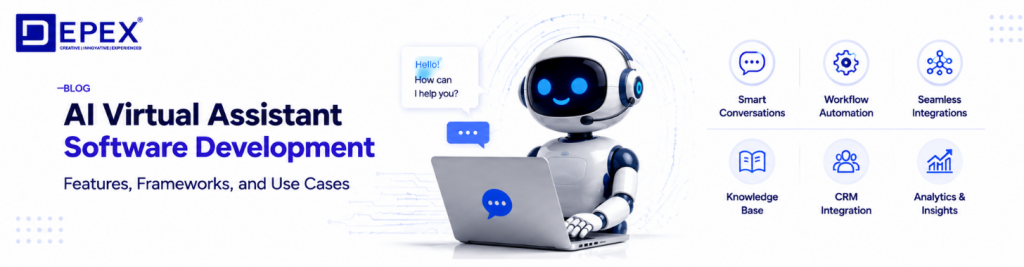
Modern agent frameworks also make virtual assistants more powerful. OpenAI describes agents as applications that can plan, call tools, collaborate across specialists, and maintain enough state to complete multi-step work. This means a virtual assistant can move beyond conversation and actually complete business processes.
Why Businesses Need AI Virtual Assistant Software
Businesses need AI virtual assistants because customers expect fast, accurate, and personalized responses. A visitor who lands on a website may not want to wait for a sales executive. A patient may want to book a doctor appointment immediately. An employee may want to check leave balance without emailing HR. A buyer may want to compare products before making a decision.
AI virtual assistants solve these problems by offering instant support and task automation. They are available all the time, handle multiple users at once, reduce repetitive work, and improve lead conversion. When integrated with CRM, ERP, payment gateways, support tools, calendars, and databases, they become a direct business growth tool.
For companies with high customer interaction volume, virtual assistants can reduce pressure on human teams. Instead of spending time on repetitive questions, employees can focus on complex tasks, relationship building, and decision making. This improves both customer satisfaction and team efficiency.
Key Features of AI Virtual Assistant Software
Natural Language Understanding
Natural language understanding is one of the most important features of virtual assistant software. It allows the assistant to understand what the user is asking, even when the message is written in a casual or incomplete way. For example, a user may write, “I need help with my order,” “Where is my package,” or “Track my delivery.” A good AI assistant should understand that all these messages are related to order tracking.
This feature improves user experience because people do not need to follow fixed commands. They can talk naturally, and the assistant can identify the intent behind the message.
Context Awareness
A strong AI virtual assistant should remember the context of the conversation. If a user says, “Show me laptops under 60000,” and then asks, “Which one has better battery life,” the assistant should understand that the second question is related to the laptop options already discussed.
Context awareness makes conversations smooth and human-like. It also reduces repeated questions and helps users complete tasks faster.
Multi-Channel Support
Businesses should be able to deploy the same virtual assistant on multiple platforms, including websites, mobile apps, WhatsApp, Facebook Messenger, Instagram, Slack, Microsoft Teams, and customer portals. Multi-channel support helps companies connect with users wherever they are active.
For example, an ecommerce company can use the assistant on its website for product search and on WhatsApp for order updates. A healthcare clinic can use it on the website for appointment booking and on mobile apps for patient reminders.
Voice Assistant Capability
Voice-based virtual assistants are useful for industries where users prefer speaking instead of typing. Voice features include speech-to-text, text-to-speech, call automation, voice search, and voice command execution.
This is helpful for healthcare, logistics, travel, education, banking, and customer support. A voice assistant can answer calls, collect user information, route requests, and provide updates without human intervention.
Personalization
Personalization allows the assistant to provide responses based on user profile, history, preferences, location, role, and past activity. For example, a customer support assistant can greet returning users by name and show their recent tickets. A learning assistant can recommend lessons based on previous progress.
Personalization increases trust and engagement because users feel that the assistant understands their needs.
Business System Integration
The real power of AI virtual assistant software comes from integrations. The assistant should connect with CRM systems, ERP software, ecommerce platforms, payment gateways, calendars, ticketing tools, inventory systems, email tools, analytics platforms, and internal databases.
Without integrations, the assistant only answers questions. With integrations, it can perform actions such as creating leads, booking meetings, generating invoices, updating customer records, checking inventory, sending emails, and assigning support tickets.
Knowledge Base and Document Search
Many companies have large amounts of business information stored in PDFs, website pages, policy documents, product manuals, FAQs, training files, and internal documents. AI virtual assistants can use retrieval augmented generation to search this content and provide accurate answers.
LlamaIndex is widely used for building LLM-powered agents over business data with workflows, making it suitable for document-based virtual assistant use cases. This is especially useful for legal, healthcare, education, finance, HR, and enterprise support assistants.
Task Automation
A virtual assistant should not only answer questions. It should automate tasks. For example, it can schedule appointments, send payment links, collect feedback, create reports, update records, remind customers, assign tasks, and escalate issues.
Task automation saves time and makes the assistant more useful for both customers and internal teams.
Human Handoff
Even the best AI assistant should know when to transfer the conversation to a human agent. Human handoff is important when the user asks a complex question, shows frustration, requests special approval, or needs personal support.
The assistant can collect important details before transferring the chat, so the human team can continue without asking the same questions again.
Analytics and Reporting
Analytics helps businesses understand how users interact with the assistant. It can show common questions, failed responses, conversion rates, user satisfaction, peak usage time, unresolved issues, and automation success rate.
These insights help businesses improve the assistant, update content, train the model, and optimize customer journeys.
Security and Compliance
Security is essential in AI virtual assistant software development. The system should include user authentication, role-based access, data encryption, secure APIs, audit logs, consent management, and compliance-ready architecture.
Industries such as healthcare, finance, education, and legal services need stronger privacy and compliance measures because the assistant may handle sensitive information.
Important Frameworks for Virtual Assistant Software Development
LangChain
LangChain is one of the most popular frameworks for building AI agents and LLM-powered applications. It provides pre-built agent architectures, integrations with models, tools, databases, and observability platforms. Developers use it to create assistants that can retrieve information, call APIs, connect with tools, and manage multi-step workflows.
LangChain is useful when a business wants a flexible assistant that can work with multiple tools and data sources.
LangGraph
LangGraph is part of the LangChain ecosystem and is useful for building stateful, multi-step, and agentic workflows. It is helpful when the virtual assistant needs to follow a controlled process, such as lead qualification, onboarding, customer support escalation, or document approval.
For complex enterprise assistants, LangGraph can help structure the assistant’s decision-making flow.
LlamaIndex
LlamaIndex is highly useful for virtual assistants that need to work with documents, knowledge bases, and private business data. It helps connect large language models with company information and makes the assistant more accurate for document search and question answering. LlamaIndex describes itself as a framework for building LLM-powered agents over data with workflows.
This framework is especially valuable for businesses that want AI assistants trained on internal manuals, policies, PDFs, product catalogs, reports, and support documents.
Microsoft Semantic Kernel
MSK is an open-source development kit that supports AI agents and integration with models through C#, Python, and Java. Microsoft describes it as middleware for building enterprise-grade AI solutions. Its agent framework supports agentic patterns inside applications.
Semantic Kernel is suitable for companies that already use Microsoft technologies, Azure services, enterprise applications, or .NET-based software systems.
OpenAI Agents SDK
OpenAI Agents SDK helps developers build agents that can plan, use tools, collaborate, and complete multi-step tasks. The official OpenAI documentation explains that agents can call tools and maintain state to complete work. OpenAI also announced updates to the Agents SDK in April 2026 for building agents that can inspect files, run commands, edit code, and handle long-horizon tasks in controlled environments.
This is useful for building advanced virtual assistants that require reasoning, tool usage, automation, and business workflow execution.
Rasa
Rasa is an open-source conversational AI framework often used for custom chatbot and virtual assistant development. It gives developers more control over intent recognition, dialogue flow, and deployment. Rasa can be useful for companies that want more ownership over conversational logic and infrastructure.
Botpress
Botpress is another platform used for building conversational assistants. It supports visual flow design, integrations, and AI-based conversation management. It is suitable for businesses that want faster chatbot development with a visual development approach.
Voice and Speech Frameworks
For voice assistants, developers may use speech-to-text and text-to-speech services from platforms such as Google Cloud, Microsoft Azure, AWS, OpenAI, or other voice AI providers. These services help convert user speech into text, process the request through AI, and respond in a natural voice.
Technology Stack for AI Virtual Assistant Software
A strong AI virtual assistant software requires a reliable technology stack. The frontend can be built using React, Next.js, Angular, Flutter, React Native, or native mobile technologies. The backend can use Node.js, Python, Django, FastAPI, Laravel, Java, or .NET, depending on the project requirements.
For AI models, businesses can use OpenAI, Anthropic, Google Gemini, Meta Llama, Mistral, or custom fine-tuned models. The database layer can include PostgreSQL, MySQL, MongoDB, Firebase, or Redis. For vector search, tools such as Pinecone, Weaviate, Qdrant, Milvus, Elasticsearch, or pgvector can be used.
Cloud deployment can happen on AWS, Microsoft Azure, Google Cloud, DigitalOcean, or private servers. For monitoring and analytics, tools like LangSmith, Prometheus, Grafana, Datadog, or custom dashboards can be added.
The final stack depends on business size, security needs, budget, expected traffic, integration requirements, and long-term scalability.

AI Virtual Assistant Software Architecture
A professional AI virtual assistant usually has multiple layers. The user interface layer allows people to interact through chat, voice, web, app, or messaging platforms. The conversation layer manages messages, context, session history, and user intent. The AI model layer processes language, generates answers, and reasons through tasks.
The knowledge layer connects the assistant with documents, databases, FAQs, product catalogs, and company data. The integration layer connects the assistant with third-party tools such as CRM, ERP, payment systems, email, calendars, and ticketing software. The automation layer triggers workflows and actions. The security layer protects user data and controls access.
When these layers work together, the assistant becomes a powerful business automation platform instead of just a simple chatbot.
Development Process for AI Virtual Assistant Software
Requirement Analysis
The first step is to understand the business goal. Depex Technologies starts by identifying what the assistant should do, who will use it, what problems it should solve, and which systems it should connect with. This stage includes defining user journeys, conversation types, supported channels, language requirements, automation goals, and expected outcomes.
A customer support assistant will have different requirements from a healthcare assistant or ecommerce assistant. Clear requirement analysis helps avoid confusion during development.
Conversation Design
Conversation design focuses on how the assistant will talk to users. It includes greeting messages, question handling, fallback responses, clarification prompts, error messages, human handoff flow, and task completion messages.
A good conversation flow should feel natural, helpful, and professional. It should not confuse users or force them to follow difficult steps.
AI Model and Framework Selection
The development team selects the right AI model and framework based on the project. A simple FAQ assistant may need a basic LLM with knowledge base search. A complex enterprise assistant may require LangChain, LlamaIndex, Semantic Kernel, OpenAI Agents SDK, or custom orchestration.
The selection depends on accuracy, cost, scalability, data privacy, integrations, and required automation level.
Knowledge Base Preparation
The assistant needs accurate business information. This may include website content, FAQs, PDFs, documents, product data, service details, policies, pricing information, and support material. The data must be cleaned, structured, indexed, and connected to the AI system.
Good knowledge preparation improves answer quality and reduces hallucination.
Backend and API Development
Backend development connects the assistant with databases, user accounts, business tools, admin panels, analytics, and automation systems. APIs are created for tasks such as appointment booking, order tracking, lead creation, payment processing, ticket generation, and customer verification.
A strong backend makes the assistant reliable and scalable.
Frontend and User Interface Development
The frontend includes the chat widget, mobile interface, dashboard, voice interface, admin panel, and reporting screens. The design should be clean, fast, responsive, and easy to use.
For business websites, the assistant should match the brand style. For internal software, the dashboard should be simple enough for teams to manage conversations, update knowledge, and check reports.
Testing and Optimization
Testing is critical. The assistant should be tested for accuracy, speed, security, conversation quality, integrations, edge cases, and user experience. Developers test different user questions, spelling mistakes, incomplete messages, multiple languages, and unexpected inputs.
After launch, the assistant should be continuously improved based on real user conversations and analytics.
Deployment and Maintenance
After testing, the assistant is deployed to the selected platforms. Maintenance includes bug fixing, model updates, content updates, performance monitoring, integration support, and security improvements.
AI virtual assistant software should not be treated as a one-time project. It improves continuously as business needs change.
Major Use Cases of AI Virtual Assistant Software
Customer Support Assistant
A customer support assistant can answer FAQs, check order status, explain policies, create tickets, collect complaints, and transfer complex issues to human agents. It reduces support workload and improves response time.
Ecommerce Shopping Assistant
An ecommerce assistant can recommend products, compare items, check availability, apply filters, answer product questions, recover abandoned carts, and guide customers toward purchase. This can directly improve conversion rates.
Healthcare Virtual Assistant
Healthcare assistants can help patients book appointments, check doctor availability, receive reminders, ask basic health service questions, upload documents, and connect with clinic staff. For healthcare projects, privacy and compliance must be handled carefully.
Real Estate Assistant
A real estate assistant can collect buyer requirements, suggest properties, schedule site visits, answer pricing questions, and generate leads for agents. It helps real estate companies respond faster to potential buyers.
HR Virtual Assistant
An HR assistant can answer employee questions about leave policy, payroll, onboarding, company rules, holidays, benefits, and internal procedures. It reduces repetitive HR queries and improves employee experience.
Education Assistant
Education platforms can use AI assistants for course guidance, student support, admission queries, test reminders, learning recommendations, and doubt solving. Schools, colleges, and edtech companies can use this to support students at scale.
Travel and Hospitality Assistant
Travel assistants can help users search packages, check bookings, ask destination questions, receive itinerary support, and manage travel updates. Hotels can use assistants for room booking, service requests, and guest support.
Banking and Finance Assistant
Finance assistants can help users understand services, check account-related information through secure authentication, answer loan queries, guide users through forms, and support customer onboarding.
Internal Business Operations Assistant
An internal assistant can help teams search company documents, create reports, manage tasks, summarize meetings, check project status, and automate routine work. This is useful for growing organizations that want better productivity.
Benefits of AI Virtual Assistant Software Development
AI virtual assistant software offers several business benefits for modern companies. It improves customer response time because users get instant answers. Operational costs can also be reduced because repetitive tasks are automated. Conversions often increase when users receive the right guidance at the right time. Employee productivity becomes stronger because teams spend less time handling repeated queries.
The software also helps businesses collect better data. Every conversation gives insights into customer needs, common problems, product interest, and service gaps. These insights can improve marketing, sales, product development, and customer support strategies.
For startups, an AI assistant can create a modern digital experience from the beginning. For enterprises, it can support large-scale automation across departments.
Cost Factors in Virtual Assistant Software Development
The cost of virtual assistant software development depends on project complexity. A basic FAQ chatbot costs less than a custom AI assistant with voice support, CRM integration, payment gateway, multilingual support, analytics dashboard, and workflow automation.
Major cost factors include UI design, AI model selection, backend development, knowledge base setup, number of integrations, voice support, security features, admin dashboard, deployment infrastructure, and ongoing maintenance.
A small business may start with a simple website assistant. A growing company may need a sales and support assistant integrated with CRM. An enterprise may need a secure multi-department AI assistant with custom workflows and role-based access.
Depex Technologies can help businesses choose the right development approach based on budget, business goals, and future scalability.
Best Practices for Building AI Virtual Assistant Software
A successful AI virtual assistant should be designed around real user needs. The assistant should have a clear purpose and should not try to do everything from day one. The knowledge base should be accurate and regularly updated. The assistant should clearly say when it does not know something instead of giving wrong answers.
Security must be planned from the beginning. Sensitive data should be protected, and users should know when they are interacting with AI. Human handoff should be available for complex cases. Analytics should be used to improve the assistant after launch.
The assistant should also be easy to update. Business teams should be able to add new FAQs, update content, review conversations, and improve responses without depending on developers for every small change.
Future of AI Virtual Assistant Software
The future of AI virtual assistant software is moving toward agentic AI. Instead of only answering questions, assistants will plan tasks, use tools, collaborate with other AI agents, and complete full workflows. This shift is already visible in modern agent frameworks, where systems can call tools, inspect files, and handle multi-step work.
In the coming years, businesses will use AI assistants as digital workers for sales, support, marketing, HR, operations, finance, and customer success. Voice assistants will become more natural. Multilingual support will improve. AI assistants will connect more deeply with business software and provide proactive suggestions.
Companies that invest early in virtual assistant software development will have a strong advantage in customer experience and automation.
Why Choose Depex Technologies for Virtual Assistant Software Development?
Depex Technologies can help businesses build custom AI virtual assistant software that matches their exact needs. Whether a company wants a customer support assistant, ecommerce assistant, healthcare assistant, HR assistant, real estate assistant, or enterprise automation assistant, Depex Technologies can plan, design, develop, integrate, and deploy the complete solution.
The team can build AI assistants with modern frameworks, clean UI, secure backend, CRM integration, API automation, knowledge base search, analytics dashboard, voice support, and scalable cloud deployment. Instead of offering a basic chatbot, Depex Technologies focuses on building intelligent software that solves real business problems.
From idea validation to MVP development, from custom AI workflow design to enterprise-level deployment, Depex Technologies can support every stage of the project.
Conclusion
Virtual Assistant Software Development is now a powerful business solution for companies that want to improve customer support, increase sales, automate workflows, and deliver smarter digital experiences. AI virtual assistants are no longer limited to basic chat replies. They can understand user intent, search business knowledge, connect with software systems, automate tasks, support voice conversations, and help users complete important actions.
For businesses, this means lower manual workload, faster response time, better customer satisfaction, stronger lead generation, and improved operational efficiency. With the right architecture, framework, development process, and integration strategy, an AI virtual assistant can become a valuable digital asset for long-term growth.
If you want to build a custom AI virtual assistant for your business, Depex Technologies can help you turn your idea into a scalable, secure, and result-driven software product. Contact Depex Technologies today to develop intelligent virtual assistant software that supports your customers, empowers your team, and helps your business grow in the AI-first digital world.